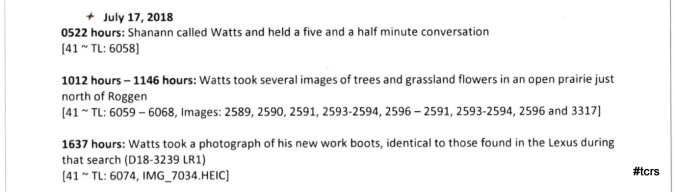
About a month before his arrest, Watts is out in open prairie at the Cervi Ranch, north of Roggen. Shan’ann had called him a few hours earlier.
When we look at these cases in hindsight, we tend to project the future into them, the end result that we know is coming. But we don’t project the past, or the situation the perpetrator is in, and knows is coming.
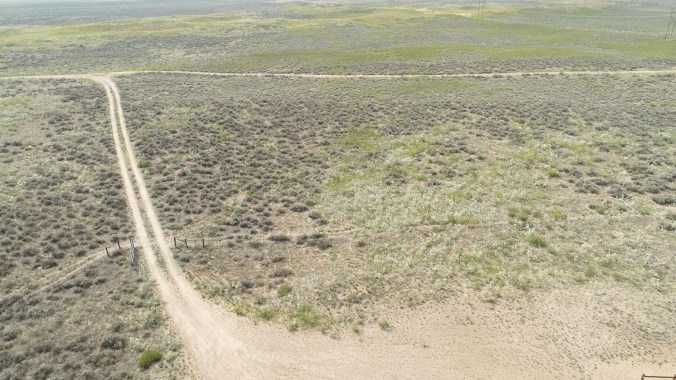
When Watts was at Cervi Ranch that day in July, taking photos, did he think this would be a good place to get rid of bodies? Because he didn’t think that thought for the first time on Sunday night/Monday morning [August 12/13]. So when did the thought, the murderous impulse, occur to him for the first time?
And when he bought his new boots, did he think of making further changes to his wardrobe, his home, his circumstances?
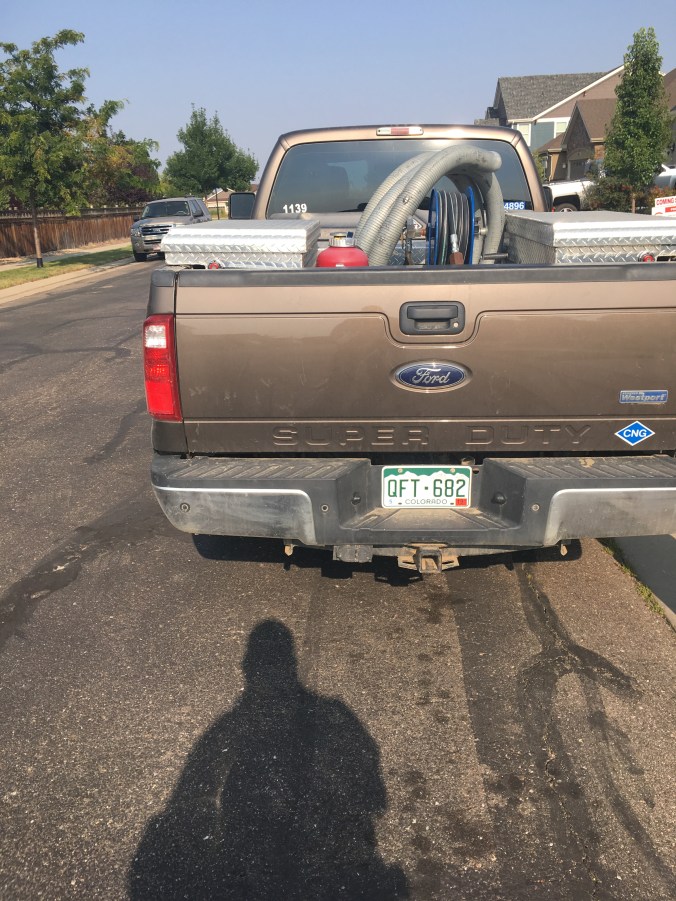 While we’re out in the country north of Roggen, let’s dip into a little Intertextuality. It’s been reported recently that a man in Crete murdered an American woman because he was frustrated with his own life [and sexual frustration was a big part of that frustration]. Incidentally, this case also started off as a “disappearance”.
Suzanne Eaton’s colleagues initially believed she had either fallen while jogging or suffered from heat exhaustion and was resting somewhere. But the Intertextual part is where her killer dumped the poor woman’s body.
From CNN:
Last Monday, her body was discovered by two locals deep inside a cave, according to Crete’s Chief of Police Konstantinos Lagoudakis. The 59-year-old Eaton was found around 60 meters (nearly 200 feet) inside the cave, beneath an air shaft that had been covered by a large wooden pallet. The underground caverns had been turned into a bunker by Nazi soldiers during the Second World War.
Wheel tracks lead officers to the suspect, police said, explaining that they had linked tracks found near the bunker to his car, which, they say, he cleaned in a graveyard after the attack on Eaton.
During preliminary questioning, the 27-year-old suspect denied having been near the bunker for a month, which raised suspicions, Lagoudakis said. Signals from the suspect’s phone also placed him near the crime scene on the day of the attack, the police chief said. Police say the suspect is a married father of two who owns farmland near the crime scene.
The local police also used aerial support to search for her, but in the end tire tracks, local knowledge and cellphone data proved more useful. Where bodies are hidden in the outdoors, look for locals with local knowledge, and often [but not always] vehicles used to transport the body. Other high-profile reference cases where bodies were disposed of outdoors: West Memphis Three, Madeleine McCann, Casey Anthony and Scott Peterson.
 True Crime Rocket Science II